
...moj racunalnik
Za enkrat:
Procesor: Intel Pentium Celeron 525 mhz
Monitor: Philips 19 ¨ Pro Brilliance
Disk: 8.4 Gb WD diska
Graficna kartica: 4MB S3 Savage
Tiksalnik : HP-Desk jet 520
Scanner: Logitech Scanman
Cd-rom enote: 6x-mitsumi
Podgana: Logitech Mouse Man Whell Cordlessmouse
Ram: 128 MB 133mhz
Tipkovnca: Cherry G83
Zvocniki: Box-Primax Soundstorm 240W pmpo
Modem: USA Robotics 33.6 int.
Mic: Creative
Pojstla za podgano: joooj pa kwa se...
Igre CD-rom: Neverhood, Fifa96, Euro 96, Flight Unlimited 1, Flight Unlimited 11, Worms2, Screamer rally, Nba 98, World Cup 98 in eno kompilacijo.
CD-rom: Win98, Office 97, Interaktivni atlas slovenije ta orenk, Slovarje,...
Programska oprema: Operacijski sistem Windows 2000 , Windows Commander, ACD See, Get Right, Netscape, Winzip, PaintShop pro , CorelDraw, MediaPlayer...
Moj
prvi pc je bil, naute vrjel 16k spomina -ZX Spectrum (kupil smo ga v Avstriji
mislm da Celovcu, k se prnas v Jugoslaviji Pc-je sploh ni dal dobit, oziroma
kupit, Pc-je je pomojm mela sam JNA za u tanke, pa take podobne vojaske
reci ,no ja kwa pa vem) jooooj kaki cajti so to bli, k smo igrce nabijal
non stop- kaseto z igro si butnu u kasetar, upalu Spectruma k je pol tulu
musko-lowdanje(5 min), da te je glava bolela, k fora je bla u tem, da glasnost
radia v katerem je bla kaseta z igro je mogla bit skor do fula, k v nasprotnm
primeru igra ni hotla prjet???
No
ja ampak igre so ble za tist cajt res dobre in lepe! (Psst, Jet pack, Chess,
Reversi, Coockies...) No pol pa enga dne dobi Dommy-bratranc (pobec) en
orenk Pc ja to je bil 286 16 Mhz s printerjem, k sm ga takrat ta zlodej
prvic sploh u lajfu vidu- matr se mi je zdel fajn k si na Pc neki narisu,
pol je pa tisto kr sprintal na list papirja uuuaaauu! Odtakrat sm ratu
nor na gajbe 20 st.
Z
bratrancm sva nabijala igre k nora (Tetris, BlockOut, Old, Test drive 1,
Danger Dave...) Neki cajta kasnej pa dobi Pc-386 (33Mhz) moj frend Miha
oziroma Knafa oziroma Muha. Tist je blo stroj, barvan ekran-uhhuhu noro
in pa zvok ne iz speakerja ampak iz Soundblasterja, mislm da je bi 8-bit
WaveBlaster sploh prva plahta od Creativa. In nato smo se skoraj preselili
k Mihatu in igrali in igrali (Doom, California games, Winter games, Dyna
blaster, WolfnStein, Lotus...) Prvic pa sem ugledu tut operacijski sistem
Windows 3.1, k je blo lepo in napredn za tiste cajte k smo bli navajen
Dos-a.
Pc-ji
so se parl in skor vsak ga je mel kle okol, tut moj naj prijatelj Miha
Burnik si ga je umislu (386-40Mhz), pa Jeraj Mare 386-40 Mhz, pol so pa
tut frendi u skuli dobival pc-je, pa Mark 486 66-mhz, k je bla poglavje
zase tistga cajta. Pol, pol se mi je pa utgal, sej sm jest mel sam enga
bozga ZX-Spectruma in tko sm se prpravu fehtat za pc, Spectruma pa ponosno
nabou na zid.
Sfehtov
sm ga za bozic leta 1994, kao da ga bom NUJN rabu za skulo pa take... ja
ja rabu za nabijat igrce, kwa pa druzga. Tako sem dobil 486 66Mhz s Soundblasterjem
seveda, zanga sm mogu fehtat dodatn! Za tiste cajte je bil to dost
uredu sploh k pomislm na tistih 540 MB placa na disku, je blo to uuuu napravm
ostalim k so ga mel po 16,40,120,270 MB, pa tut igre so laufale k madona-dobra
fora je bla z Doomom k smo ga prej nabijal pr Knafi na 386 in sploh nismo
vedl da igra riba k madona, dokler ga nismo pognal pr men k je laufou res
hitr in normaln, tko da sam ene par tednov in Knafa je mel nou Pc 486 100Mhz
s 17-inchnim ekranom, k se mi je takrat zdel velik ko praln stroj. Na mojm
pc-ju se je tiste cajte dal res vse delat-Win 95, pa muska, pa printer
HP, pa igrat, ma vse no. Prhajale pa so tudi enote CD-rom, tko da so ble
diskete-tavelke 1.2MB, in 1.4MB tamale skor za fuknt u maline. No cajti
so mineval in pc je zastarel, tko sm 2 leti kasnej nabavu enoto Cd-rom,
poleti 1998 pa novo plato in procesor Pentiuma 100Mhz ga kmalu prodal in
kupu procesor 133Mhz, zamenov plato, dokupu nov Cd-rom, graficno kartico
iz 1-drama na 4-drame, kupu pa sm tut nekej rama, tko sm ga mel prej 8mb,
nato pa 32mb, zamenu sm tut disk in kupu dva rabljena, tko da je kapaciteta
narasla vsega skupej na dobr GB., ko pa sm pr Knafi vidu tut internet in
modm, pa sm kupu tut to, account pa mi je tist cajt zrihtov on prek svoje
skule na GIMB, zdaj pa si account delim z Dommy-em mojim bratrancem (thnx),
pol bomo pa vidl kako bo.
Tko
sm dobr cajt mel eno zmajano staro gajbo za krompir, k se upali kukr vetr
piha, tko da dostkrat ko sem kej hotu delat na pc-ju nisem mogu, saj mi
kozovc ni upalu kr tko, no ja treba ga je blo znat-bum tresk pa je blo
za kero urco, pol je pa spet crknu... ja ja tko je k dnarja za pc-je
ni a ne ?No ja pa bli so cajti k je ta gajba lepo delala, vse skupi
je blo preperel in staro.
Pa
smo sparal, pa sparal, pa se enkrat sparal da zaj mam PC-tak kot je napisano
cisto na zacetku. To, to pa je zdaj cisto drugacna pesem. Dela potiho,
hitro, brez vsakrsnih problemov...Se posebno sem si zelel velikega in kvalitetnega
monitorja ! Ja, ja zdej se je pa tezko usest za 14, 15, 17 " ekran ! Ja,
ja kje mas pa ekran, aja kle je, u je mejhn ! 19" je lih nekak, tko da
se normaln da delat. Kasnega si zelim ? Cim vecjega !!! 21" 24" od Philipsa
seveda ! Pridejo se na vrsto ko bojo cekini !! No ja upam !! Tut ostali
frendi neki kupujejo, tko da ma Knafla P11-350Mhz, Dommy P-200Mhz MMX,
Burnik P11...
Tko!
Rad
pa bi se tudi zahvalil za servisiranje in pomoc:
-Alesu Malnersicu
-Mihatu Knaflicu
-Mihatu Burniku
...igre
Na
mojm Pc-ju se dost igrat ne da, razn kakih pustolovskih, strategij, in
miselnih, vse kar je drugo je za u maline, kot naprimer strelske, dirkacine,
letalske simulacije...pac nimam 3D pospesevalca ! Pa si ga zelim ? NE !
Iger res vec dosti ne spilam, nekako bi lahko rekel, da sem jih prerastel,
preigral...razen kakih miselnih!!
Racunalnik
imam zaradi dostopa do interneta. Nic vec !
Tko
med igrami res ne morem dost zbirat.
Endorfun
-res moja naj, naj igra.
-zasvojenost
-logika
-igra za vsakogar
-sublimirana sporocila, in nora muska
-proti jezi, stresu in dolgcajtu
Neverhood
-res odtrgana pustolovscina
-narejena je s 3000kg plastelina in gline,50.000 slik in animacij
-odpileno dobra muska, igra pa je polna humorja in iznajdljivosti
-glavni junak je Klaymen, ki se rodi v Neverhoodu in raziskuje
dezelo polno pasti, groznih zverin in zanimivih strojev.
Dolgo nazaj preden se Klaymen rodi je bil kralj te dezele
Hoborg, katerega prevara njegov vdani pomocnik Klogg, ki mu ukrade
cudezno krono. Hoborg pa brez krone zaspi se pred tem pa
naredi Klaymena s katerim naj bi si delil ta svet, da mu ne bi
bilo dolgcajt....
Tako je na tebi, da vodis Klaymena po Neverhoodu in ga odresis
prekletstva, tako da krono vrnes tistemu, kateremu res pripada,
da pa se to zgodi moras Klaymena voditi preko zvitih ugank,
pasti in skrivnih prehodov.
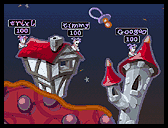
Worms 2 ali Worms Armageddon
-nadaljevanje prekleto dobrih wormsov reinforcementsov
-neverjetno dobra v nacinu za dva igralca
-s to igro posl u pizdo mater svoje prijatelje in se mascuj svoji
druzini s popolnoma novo artilerijo!
-SVGA grafika, res odpileni videji, polno novih zvokov tudi slovenskih
ki jih dobis na mojem pageu.
-torej novi wormi so lepi, do zob oborozeni, se bolj krvolocni se
bolj kovnejo, se bolj samozavestni in vecje barabe kdajkoli!
Atomic Bomberman
-ni vecjega zakona kot grupni bomberman
-nadaljevaje stare dobre Dyna Blaster
a mnogo lepsa, bolsa in bolj podla, saj bombe zdaj
Bomberman tudi brca in odbija.
-toda nekej pa pri tej igri smrdi, to so ogabne
in glupe sobe.
Need for speed
-lepa grafika, dobra igralnost, skratka igra ki trga gate
-igra rata odpilena sele na netu ali mreze- ene 5
Pc-jev zvezanih, vsak svoj avto in Scooter v pogonu
Cd-rom to rula!!!
-Ampak pozor fotrov avto nima opcije Start new game!!
Flight unlimited
-prava simulacija letenja z osuplo SVGA grafiko, k te
res vrze v resnicna akrobatska letala skupaj z
instruktorjem, ki te nauci letenja od prvega vzleta
do lupingov.
Tetris
-tukaj se zgodovina iger res zacne
-stara a se vedno dobra igra (44kb)
Ostale
igre ki sem jih se preigral pa so:
-Phantasmagoria
1 in 2 ( grozljivka, pustolovscina)
-Discworld
(pustolovscina)
-Lula
(sex pustolovscina)
-Little
big adventure (pustolovscina)
-
Warcraft 2 (strategija)
-Red
Alert (strategija)
-Settlers
2 (strategija)
-Starcraft
(strategija)
-
Flight Unlimited 1 in 2 (letalska simulacija)
-Colin
Mc Rae rally (dirkacina)
-Fifa
96, 97, World Cup 98 (nogomet)
-Quake
(streljacina)
-
Nfs (dirkacina)
-Earth
worm Jim (arkada, ploscada)
-Lion
king (arkada, ploscada)
-Lemmings,
Lemmings 3D (miselna strategija)
Se sprasujes katera igra na svetu je najbolj znana, najbolj popularna, najbolj prodajana in res najboljsa med najboljsimi ??
...to je seveda Tetris

Kaj je Tetris ?
Tetris
je res enostavna, hitro osvojljiva in grozno nalezljiva igra, spada pa
med igre, ki jim pravimo Puzzle ali sestavljanke. Naloga igranja Tetrisa
je v tem, da majhne padajoce predmete, ki imajo 7 oblik (pravimo jim Tetraminos),
sestavljene pa so iz 4 majhnih kockic, ko padajo, obracamo tako, da na
spodnje lezece premete, ki so ze polozeni ali pa ko jih igralec polozi
pred tem, zapolni vrsto ali prostorcke med njimi. Ko igralec te prostocke
med polozenimi Tetramini zapolni, se vrsta podre (navpicno) in nastane
prostor za nove predmete, ki padajo iz sobe v sobo vedno hitreje. To je
vse !
Kaj je tetramino ?
Je
predmet, ki pada, sestavljen je iz 4-ih delov oziroma kock, pojavlja pa
se v 7-ih razlicnih oblikah.
Zakaj je tetramino sestavljen iz 4-ih kock, oziroma delov ?
Alexey
Pajitov, izumitelj igre Tetris, je bil programer in je za testitanje svoje
nove opreme velikokrat napisal novo igrico. Nekega dne, je kot test naredil
igro, ki je vsebovala 12 razlicnih oblik predmetov, sestavljeni pa so bili
iz 5-ih delov. Kmalu se je zavedel, da tako tezko sestavljeni predmeti,
niso namenjeni igranju, saj je bilo igranje res izjemno tezko, se posebaj
pri povecani hitrosti. Tako je svoj program, oziroma igro napisal z 7-razlicnimi
oblikami, sestavljene pa so bile iz 4-ih delov. Tako se je rodil Tetris
!
Kaj je igralni prostor (playfield) pri Tetrisu ?
Igralnemu prostoru lahko recemo kar vodnjak (the well). Vsi Tetrisi imajo igralno polje, sestavljeno z 10-bloki sirine X 20-bloki visine, izjema so le nekateri Tetrisi, ki delujejo na prenosnih sistemih (npr. Tetris za GameBoy, Tetris Jr. in Tetris za Windows CE ), ki imajo le po 8-blokov naokoli.
Kako vem kateri predmet bo padel naslednji ?
Vrstni
red kateri predmet oz. Tetramino se bo pojavil, je odvisno od nakljucne
izbire stevilcnega generatorja. Vecina Tetris-ov pokaze naslednji predmet
v zgornjem desnem kotu. Tako lahko enostavneje planiramo, kako bomo Tetramine
zlagali in razvrscali.
Tetris na dolgo in siroko (zal pa samo v anglescini, ker mi prevajanje res ne gre od rok )
Tetris is one of the few games that achieves ultimate popularity. It is remarkably simple, yet remarkably difficult. It's been ported to every computer and game console known to man, and has sold millions cartridges, tapes, and disks across the land.
Besides that, it also led to one of the most interesting legal battles
in the history of video games, leading to
the famed Tengen version of Tetris and to the downfall of a few companies.
It's a pretty cool story, so let's
get down to business. Hold on for a second while I set the time machine
to cruise control..
June 1985
Inspired by a pentominoes game he had bought earlier, Alexey Pazhitnov
creates Tetris on an Electronica
60 at the Moscow Academy of Science's Computer Center. It is ported to
the IBM PC by Vadim
Gerasimov and starts spreading around Moscow. Pazhitnov gets a small degree
of fame for his program.
July 1986
The PC version makes its way to Budapest, Hungary, where it is ported to
the Apple II and Commodore
64 by Hungarian programmers. These versions catch the eye of Robert Stein,
president of the British
software house Andromeda. He plans to get the rights to the PC version
from Pazhitnov directly, and to
get the other versions from the Hungarian programmers. Even before Stein
gets in touch with Pazhitnov or
the Academy, he sells all the rights to Tetris (except for arcade and handheld
versions) to Mirrorsoft UK
and its USA affiliate, Spectrum Holobyte, owned by Robert Maxwell's Pergamon
Foundation.
November 1986
Stein wires a contract for the rights to Tetris to the Academy. Although
Pazhitnov would later say that he
did not mean to give a firm go-ahead to the deal, Stein goes ahead and
flies to Moscow to sign the
contract. He returns empty-handed; the Russians made up for their lack
of knowledge of the video game
world with obstinance. Stein makes a plan to essentially steal Tetris,
to claim it was invented by the
Hungarian programmers.
Meanwhile, the IBM PC version of Tetris is released by Spectrum Holobyte
and Mirrorsoft, causing an
instant sensation not only as an obscenely addictive game, but also as
"the first game from behind the iron
curtain". The game is filled with graphics of Russian themes (battles,
Matthias Rust landing his Cessna on
Red Square, Yuri Gagarin's first space mission). Stein still does not legally
own any rights to Tetris.
June 1987
Stein presses for and finally gets a license giving him the rights to make
Tetris for the IBM PC and
compatibles "and any other computer system". Now he owns the copyrights
to Tetris, but he still doesn't
have a contract with the Russians.
January 1988
Tetris is released for all home computers. It gets glowing reviews and
sells quickly in computer stores.
Stein's plan to "steal" the rights to Tetris is foiled when the CBS Evening
News interviews Pazhitnov as
the inventor of the game. A new company, ELORG (Electronorgtechinca), takes
over the negotiations with
Stein.
ELORG's director, Alexander Alexinko, realizes that Stein is giving out
rights he doesn't have and
threatens to cut off any deal. Stein, in turn, threatens to start an international
situation.
May 1988
After months of bickering, Stein signs a contract with ELORG to make Tetris
for computers. The contract
expressly forbids rights to arcade and handheld versions, and any other
mediums "which we did not dream
about yet". Meanwhile, Tetris has become the top-selling computer game
in England and the United
States.
July 1988
Stein meets with Alexinko in Paris to work out arcade rights to Tetris.
Alexinko has quite a different
agenda; he hasn't seen any money from Stein at all yet. Meanwhile, Spectrum
and Mirrorsoft are
sub-licensing their rights. Spectrum gives Bullet-Proof Software the rights
to make Tetris video and
computer games in Japan; at the same time, Mirrorsoft gives Atari Games
the exact same rights in Japan
and North America. The two companies start infighting.
Robert Maxwell, owner of both Mirrorsoft and Spectrum, sides with Mirrorsoft
on the matter. Atari starts
plans to release an arcade and NES game (under the Tengen label). Bullet-Proof
Software still has the
computer rights in Japan; BPS president Henk Rogers successfully gets the
rights to release a video-game
version later in the year. Tetris is released for the Famicom in early
November 1988; eventually, two
million cartridges would be sold.
November 1988
The Game Boy is undergoing development. Nintendo of America head Minoru
Arakawa wants to make
Tetris the pack-in game; he enlists Henk Rogers to get the handheld rights
to Tetris for him. Rogers
contacts Stein but basically gets stonewalled by him, so Rogers decides
to fly to Moscow to get the rights
himself. Stein, sensing why Rogers asked for the rights, flies to Moscow
as well. Robert Maxwell's son,
Kevin, also decides to fly to Moscow to straighten out what is by now a
large-scale licensing mess. The
three men fly into Moscow at the exact same time.
February 21, 1989
Rogers gets to ELORG representative Evgeni Belikov first. He impresses
Alexey Pazhitnov and the
Russians, and signs a contract for the handheld rights to Tetris. Afterward,
Rogers shows off the Famicom
version of Tetris to the Russians. Belikov is shocked. He didn't give Rogers
the rights to make a console
version! Rogers explains that he got the rights from Tengen; Belikov has
never heard of Tengen! Rogers,
trying to appease the Russians, tells Belikov the part of the story Stein
did not tell him, and writes him a
check for royalties on the Tetris cartridges he has already sold, with
promises of more checks. He sees
that he has a chance to get all the console rights to Tetris, but knows
that the much larger Atari will fight
him. Fortunately, he has Nintendo on his side!
A reminder: Robert Stein's original agreement was only for computer versions
of Tetris. Any other rights
he gave out weren't his to sell.
Later, Stein makes it to ELORG. Belikov makes him sign an alteration to
the original contract defining
computers as "PC computers which consist of a processor, monitor, disk
drive(s), keyboard and
operation system". Stein misses this line defining computers; he later
realizes that it was all a big
orchestration on Rogers' part to get his rights from Stein. The next day,
he is told that, although he can't get
the handheld rights at the moment, he can get the arcade-game rights. He
signs the contract for them three
days later.
February 22, 1989
Kevin Maxwell visits ELORG. Belikov takes out Rogers' Famicom Tetris cart
and asks him about it.
Maxwell was unaware that his own company gave some rights to Atari Games
until he reads Mirrorsoft's
name on the cartridge. Maxwell asserts that the cart is a pirated copy,
and returns to his agenda of getting
the arcade and handheld Tetris rights. He leaves with only the right to
bid on any rights remaining on
Tetris.
The final scorecard: Kevin Maxwell walks off with a piece of paper, Robert
Stein with the arcade rights,
and ELORG with conclusive evidence, thanks to Maxwell's assertion that
any Famicom carts are pirates,
that it never sold the video game rights. If Maxwell wanted those rights
it would have to outbid Nintendo.
Henk Rogers has the handheld rights and tells Arakawa at NOA that the console
rights are up for grabs.
BPS makes a deal to let Nintendo make Tetris for Game Boy; a deal that
was ultimately worth between
$5 and 10 million to BPS.
March 15, 1989
Henk Rogers returns to Moscow and makes a gigantic offer for the console
rights to Tetris on behalf of
Nintendo - an offer that, although undisclosed, was high enough that Mirrorsoft
did not try to match it.
Arakawa and NOA chief executive officer Howard Lincoln fly to the USSR.
March 22, 1989
A contract for the home videogame rights is finalized with Nintendo, which
insists on a clause that the
Russians would come to America to testify in the legal battle that would
undoubtedly ensue after word of
the contract comes out. The advance cash for ELORG is reported to be around
$3 to 5 million. Belikov
wires Mirrorsoft saying that neither it, Andromeda, or Tengen were authorized
to distribute Tetris on
video game systems, and that those rights are now given to Nintendo. The
Nintendo and BPS executives
have a party that night in their Moscow hotel room.
March 31, 1989
Howard Lincoln gleefully faxes Atari Games a cease-and-desist order to
stop manufacturing any version of
Tetris for the NES. Both Atari and Robert Maxwell become furious. Tengen
responds to Nintendo on
April 7th that they completely own the rights to home versions of Tetris.
April 13, 1989
Tengen files an application for a copyright of the "audiovisual work, the
underlying computer code and the
soundtrack" of Tetris for the NES. The application does not mention Alexey
Pazhitnov or Nintendo's
rights to the game.
Robert Maxwell, meanwhile, is using his vast media empire to try to get
Tetris back. He contacts both the
Soviet and British governments to intervene on the Tetris matter. Infighting
between the Communist party
and ELORG begins, and Maxwell gets a promise from no less than Mikhail
Gorbachev that he "should no
longer worry about the Japanese company".
In late April, Lincoln flies back to Moscow and learns of ELORG's being
put upon by the government. In
the middle of the night, he receives a call from NOA that Tengen has sued
Nintendo.
The next day, he starts interviewing Belikov, Pazhitnov, and many others
at ELORG, to make sure that
Nintendo's case for the Tetris home rights is airtight. NOA immediately
countersues Tengen, and evidence
begins to be gathered.
May 17, 1989
Tengen releases their version of Tetris with a full-page ad in USA Today,
despite the coming legal battle.
June 1989
The court case between Tengen and Nintendo begins.
The battle mostly hinged on one matter: Was the Nintendo Entertainment
System a computer, under the
definition in the contract that Belikov made Stein sign, or a video-game
system? Atari argued that the NES
was meant to be a computer, due to its expansion port and the existence
of a computer network for the
Famicom (short for "Family Computer") in Japan. Nintendo's argument was
more to the point: the
Russians at ELORG had never had the intention of selling the video game
rights to Tetris; the definition of
"computer" in Stein's contract proved it.
June 15, 1989
A hearing is held about the injunctions Tengen and Nintendo had given each
other to cease manufacture
and sale of their respective versions of Tetris. Judge Fern Smith decides
that neither Mirrorsoft nor
Spectrum Holobyte had been granted the video game rights, so therefore
it could not have legally given
those rights to Tengen. Nintendo's injunction request is granted.
June 21, 1989
Tengen's version of Tetris is taken off the shelves, and manufacture of
the Tengen version is ceased.
Several hundred thousand copies of Tengen Tetris, sitting in their boxes,
lie in a warehouse.
July 1989
Nintendo's version of Tetris for the NES is released. About three million
are sold in the US. At the same
time, the Game Boy, with Tetris as the pack-in, is being sold. America
gets Tetrisized.
This ends the main history of Tetris; the lawsuit between Nintendo and
Atari would continue to drag on
and on and on (it was finally finished up by 1993).
Epilogue
Atari Games still released an arcade version of Tetris, selling about twenty
thousand units. Atari Games
was recently bought up by Williams/WMS; the fate of the Tengen Tetris carts
lying in warehouses is
unknown. In all likelihood they were bulldozed since Tengen could not legally
get rid of them any other
way. If the figures are to be believed, there are about one hundred thousand
Tengen Tetris cartridges
floating around; a less-than-average run by NES standards, but still nowhere
near an impossible cart to
find.
Robert Stein made, in total, about $250,000 on Tetris. He could have made
a great deal more, of course,
but Stein had trouble getting Atari and Mirrorsoft to pay him royalties
for the (bogus) rights he sold them.
Spectrum Holobyte had to organize another deal with ELORG just to hold
on to the computer rights to
Tetris.
Robert Maxwell's large-scale media organization collapsed in the midst
of the struggle, and Robert
Maxwell himself died suspiciously as questions rose about whether he was
entirely honest about his
business dealings. As a result, Mirrorsoft UK faded away as well.
The big winners of the whole affair were Henk Rogers, president of BPS,
and Nintendo themselves. How
much did Tetris make for Nintendo? That's difficult to answer, considering
that Tetris being the pack-in
for the Game Boy enticed customers to buy the Game Boy.. and from there,
buy other Game Boy carts.
Bringing all this into account, the figure can go up and up and up. About
30 million Game Boy Tetris carts
have been made.
As for the Russians, no one made big money from Tetris except for the Soviet
government. As the USSR
broke up, the people at ELORG and the Academy scattered across the country.
Alexey Pazhitnov made nearly no money from Tetris itself. ELORG made, then
cancelled a deal that
would have given him merchandising rights to Tetris. Still, Pazhitnov was
happy that the game he created
became famous world-wide, and he did get an 286-clone from the Academy
as a reward; he also had a
much nicer apartment than most of his colleagues. In 1996, with the financial
backing of Henk Rogers, he
organized The Tetris Company LLC, and is now finally getting royalties
for his creation.
TETRIS: THE PERFECT PUZZLE GAME!
Tetris creator, Alexey Pajitnov, was inspired to
become a mathematician by a lifelong love of
puzzles. In 1985, Pajitnov was a specialist in
computer sciences at the Computer Center of the
Academy of Sciences in Moscow. While at the
Computer Center (also known as AcademySoft),
Alexey still played with puzzles, but in a far different
context. While working as a programmer in the field
of speech recognition and artificial intelligence,
Pajitov often programmed games as simple tasks to test new equipment. On
this occasion, he chose the traditional puzzle Pentomino which required
placement of 12 different-shaped pieces formed out of five squares to be
arranged in a certain order in a box. Pajitnov remembers the moment he
knew
he had a hit game. "When I wrote the program for rotation of pieces and
I saw
how it worked, poomph! I knew it would be great in real time," he reminisces.
He also realized the 12-5 combination was too much for real time, so he
reduced the program to seven shapes of four square blocks. Thus the name
Tetris, taken from tetra, the Greek word for "four." It took him only two
weeks
to program the prototype.
Pajitnov, however, was programming on an old Russian computer without
graphics, in Pascal. While his colleagues were rabid about the game, Pajitnov
realized he would reach a wider audience if the game could be converted
to run
on the IBM PC.
Since he had little experience with the Western machine, he enlisted the
help
of his friend, Vadim Gerasimov, a 16 year old "hacker" who mastered the
PC in
a month. Soon after, a PC version of Tetris was introduced and spread like
wildfire throughout Moscow. Pajitnov recalls, "At that time there was no
software market in Russia, only the distribution of unauthorized copies.
Within
weeks, the game was being played on every PC in Moscow!"
It took much longer for Tetris to arrive in America. A Hungarian programming
consortium, via their London agent, Andromeda Software Ltd., sold the U.S.
Tetris PC rights to Spectrum Holobyte in Alameda, California. For Tetris,
Spectrum added rich, color graphics and music based on traditional Russian
themes. At the 1989 Software Publishers Association Awards, the "Oscars"
for
the software industry, Tetris set records when it won an unprecedented
four
Excellence in Software Awards.
However, Tetris experienced perhaps it's greatest success on Nintendo's
Game Boy system, selling well over 30 million copies on this system alone.
The man responsible for heading to Russia and tracking down Alexey Pajitnov
and the console system rights to Tetris was entrepreneur Henk Rogers.
Rogers and his company Bullet-Proof Software were also responsible for
several important game innovations, including the Soft Drop and Line Clearing
Bonuses. Alexey and Henk have remained lifelong friends.
While Tetris made Pajitnov a sort of folk hero, the phenomenally successful
game did not make him rich. The royalties for the original Tetris went
to the
Academy and the Soviet Ministry of Commerce. Comments Pajitnov, "I said,
if
you can't give me money, that's OK. Just help to get this game to the West.
And they did."
In 1996, with the help of entrepreneur Henk Rogers, The Tetris Company,
LLC.
was organized. Under this new structure, Alexey would now receive a royalty
on sales of all Tetris products. Blue Planet Software, Inc., San Francisco,
California, is charged with development, licensing and marketing for all
Tetris
products. The company protects the Tetris brand and insures Alexey's creation
remains popular for years to come.
Alexey Pajitnov - the God of Tetris
Alexey Pajitnov was inspired to become a mathematician by a lifelong love
of puzzles. In 1985, Pajitnov was
a specialist in computer sciences at the Computer Center of the Academy
of Sciences in Moscow. While
working as a programmer in the field of speech recognition and artificial
intelligence, he often programmed
games as simple tasks to test new equipment.
On one occasion, Pajitnov chose the traditional puzzle Pentomino which
required placement of 12
different-shaped pieces formed out of five squares to be arranged in a
certain order in a box. He remembers
the moment he knew he had a hit game. "When I wrote the program for rotation
of pieces and I saw how it
worked, poomph! I knew it would be great in real time," he reminisces.
He realized, however, that the 12-5
combination was too much for real time, so he reduced the program to seven
shapes of four square blocks.
Porting
Pajitnov was programming on an old Russian computer, Electronica 60, without
graphics, in Pascal. While his
colleagues were rabid about the game, Pajitnov realized he would reach
a wider audience if the game could
be converted to run on the IBM PC. Since he had little experience with
the Western machine, he enlisted the
help of his friend, Vadim Gerasimov, a 16 year old "hacker" who mastered
the PC in a month. Soon after
(June 1985 to be exact), a PC version of Tetris was introduced and spread
like wildfire throughout Moscow.
Pajitnov recalls, "At that time there was no software market in Russia,
only the distribution of
unauthorized copies. Within weeks, the game was being played on every PC
in Moscow!"
In the summer of 1986 the game arrived in Budapest, Hungary, where it was
ported to the Apple II and
Commodore 64 by Hungarian programmers.Pajitnov then sold all the rights
to Tetris (except for arcade and
handheld versions) to Mirrorsoft UK and its USA affiliate, Spectrum Holobyte,
owned by Robert Maxwell's
Pergamon Foundation. Spectrum added rich, color graphics and music based
on traditional Russian themes, and
markeded it as "the first game from behind the iron curtain". At the 1989
Software Publishers Association
Awards, the "Oscars" for the software industry, Tetris set records when
it won an unprecedented four
Excellence in Software Awards.
However, Tetris experienced perhaps it's greatest success on Nintendo's
Game Boy system, selling well over
30 million copies on this system alone. The man responsible for heading
to Russia and tracking down Alexey
Pajitnov and the console system rights to Tetris was entrepreneur Henk
Rogers. Rogers and his company
Bullet-Proof Software were also responsible for several important game
innovations, including the Soft Drop
and Line Clearing Bonuses.
The Tetris Company
While Tetris made Pajitnov a sort of folk hero, the phenomenally successful
game did not make him rich. The
royalties for the original Tetris went to the Academy and the Soviet Ministry
of Commerce. In 1996, with
the help of entrepreneur Henk Rogers, The Tetris Company, LLC. was organized.
Under this new structure,
Alexey would now receive a royalty on sales of all Tetris products. Blue
Planet Software, Inc., San
Francisco, California, is charged with development, licensing and marketing
for all Tetris products.
What I've neglected to tell you so far, is that 'The Tetris Company' is
regarded as the Big Bad Wolf by
many tetrimaniacs, and that the game has led to one of the most interesting
legal battles in the history of
video games, leading to the famed Tengen version of Tetris and to the downfall
of a few companies. It's a
pretty cool story, but you'll have to read it somewhere else. It's now
time to get into detail about the
playing itself...
Tetris igre,
ki jih imam na zalogi pa so:
-originalni,
stari Tetris (44kb)
-BlockOut
(3D Tetris) (179kb)
-Tetripz (Tetris,
vsebuje droge, kot so trava, LSD...res noro !!) (204kb)
-Bricks 2000
(mini tetris) (553kb)
-Bedter (mini
tetris) (1657kb)
-CubeMaster
2000 (nastavljiv po svojih zeljah !) (2,5 mb)
-EiTris za
dos (multiplayer, vojna en proti drugemu ali cooperative)(981kb)
-EiTris za
Win (multiplayer, vojna en proti drugemu ali cooperative) (2,53 mb)
-TetraBlocks
(2 player cooperative ali en proti drugemu) (2,38 mb)
-TetriNet
(Internet Tetris, multi player, cooperative)
Posli mi e-mail da
ti ga ali ti jih poslem !!! 
...hack the planet

Enter
crack and patch site
¸ 